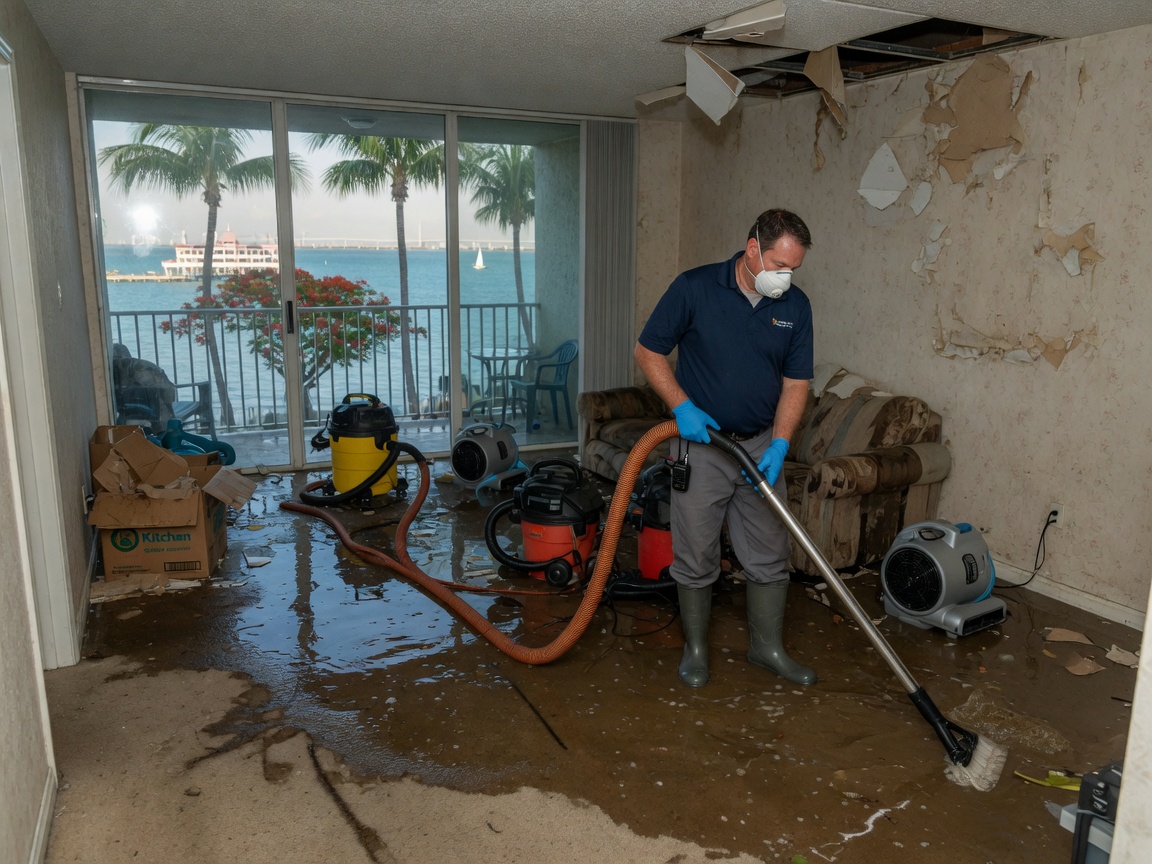
St. Petersburg's flat terrain and sandy soils let water spread quickly under slabs and into crawl spaces common in mid-century homes throughout the Old Northeast and Kenwood neighborhoods. Technicians must pull baseboards early and use moisture meters on plaster walls that hold hidden saturation far longer than drywall. High humidity after afternoon thunderstorms forces the use of commercial dehumidifiers rated for coastal conditions to keep secondary mold growth from starting within 48 hours.
Pinellas County building practices from the 1960s and 1970s often left HVAC ducts in attic spaces with minimal insulation, so roof leaks during hurricane season frequently soak insulation and drip into living areas days later. Restoration crews isolate affected zones with containment barriers and run negative air machines to protect unaffected rooms in these tightly packed historic blocks. Sewage backups from aging municipal lines require full PPE protocols and disposal at permitted Pinellas County facilities.
After Tropical Storm or hurricane-driven rain, standing water in low-lying yards around Snell Isle and Shore Acres can remain for days because storm drains back up. Extraction trucks with 500-gallon tanks handle the volume while crews install floor mats and inject drying air into hardwood to prevent cupping. Every job ends with a post-dry verification using thermal imaging so homeowners know when it is safe to reinstall flooring or cabinets.
Technician insight
In St. Petersburg the thing that catches most people out with water damage restoration is how fast moisture moves through the plaster-and-lath walls in homes built before 1960, especially after a sudden summer downpour that soaks the sandy soil and then wicks upward for days.
Old Northeast Home After Thunderstorm
Heavy rain overwhelmed gutters on a 1952 bungalow, sending water under the slab and into the living room. Crews extracted water, placed drying mats under the hardwood, and ran dehumidifiers for four days. Final scans showed all moisture removed before any flooring replacement.
Water Damage Restoration Services We Offer
✓Emergency Water Extraction
Rapid removal of standing water from living spaces using truck-mounted pumps sized for Pinellas County storm volumes.
✓Structural Drying and Dehumidification
Placement of industrial air movers and low-grain dehumidifiers to pull moisture from plaster, hardwood and concrete slabs common in St. Petersburg homes.
✓Crawl Space Flood Cleanup
Pumping and drying of low-lying crawl spaces found under many 1950s–1970s houses in Kenwood and Historic Uptown after heavy rains.
✓Appliance Leak Restoration
Isolation and drying of water from washing machines, water heaters and refrigerators that leak onto tile or subfloors in older St. Petersburg kitchens.
✓Storm Surge Damage Drying
Specialized extraction and drying after saltwater intrusion from Tampa Bay surges that affect homes in Shore Acres and Snell Isle.
Water Damage Restoration Cost in St. Petersburg, FL
| Service | Typical Range | What Affects It |
|---|---|---|
| Emergency Water Extraction | $300–$900 | Depends on gallons removed and whether crawl space or slab access is needed. |
| Structural Drying Setup | $400–$1,200 | Number of rooms and length of equipment run time in humid summer conditions. |
| Crawl Space Drying | $500–$1,500 | Varies with standing water depth and debris removal in older Pinellas homes. |
| Storm Surge Saltwater Cleanup | $600–$2,000 | Higher due to corrosion protection and disposal requirements after bay surges. |
Ranges are typical for St. Petersburg, FL and confirmed with an exact written quote before any work starts.
How it works
- 1
On-Site Assessment
Technician arrives within hours, maps moisture with meters, and identifies hidden water paths through walls and under floors typical in St. Petersburg construction.
- 2
Water Removal
Pumps and extractors pull standing water while protecting unaffected rooms in dense neighborhood layouts.
- 3
Drying And Monitoring
Equipment runs until readings drop below 12 percent, with daily checks to prevent mold in humid coastal air.
- 4
Final Verification
Thermal scans and moisture logs confirm the structure is dry before any rebuild work begins.
Pricing
Upfront quotes provided after inspection; ranges vary by water volume and access.